Dieser Text liegt bisher nur auf Englisch vor.
Bonsai garden
The craft the name comes from.


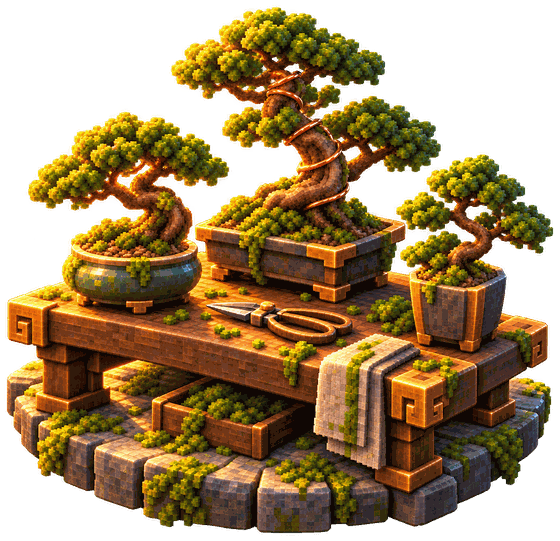
盆栽園 — pronounced bonsai-en (roughly “bone-sigh-en”).
Literally three parts: 盆 (bon, tray) + 栽 (sai, planting) + 園 (en, garden/nursery). A bonsai garden — the working nursery where the trees are cultivated, trained over decades, and sold. Functionally the bonsai-specific Baumschule.
One footnote on the lineage: the word bonsai itself was coined only about 200 years ago in the early 19th century, whereas the art form it represents dates back roughly 1,300 years. Before then the practice went by 鉢植え (hachiue, “pot planting”) or 鉢の木 (hachi-no-ki, “the potted tree”); a Heian- or Kamakura-era cultivator would not have hung the 盆栽園 sign on the gate. The modern, idiomatic equivalent of Baumschule for bonsai is unambiguously 盆栽園.
For the broader generic Japanese for tree nursery without the bonsai specialization: 苗圃 (byōho), or in everyday speech 植木屋 (uekiya) — the Edo-period gardener’s shop.
Cross-references
lore/roles.md— the role-titles of the workshop’s gardeners (Aruji, Jūshoku, Niwa no Mamoribito + Bonsai Enchō, Shitsurae-shi, Shikan, Saibai-ka, Genshi)- Gardeners — the prose reading of who tends the garden
lore/naming-pattern.md— the *-sai naming logic
Sealed
by Hissai, owner, on 2026-10-16 · fingerprint 0180124c…f3af
Check the fingerprint · don’t trust the garden, check the signature